
All opinions are always 100% honest and my own. As an Amazon Associate I earn from qualifying purchases. I also participate in: CJ Affiliate; eBay Partner Network; Rakuten Affiliate Network; ShareASale; Walmart Affiliate Program; independent affiliate networks.
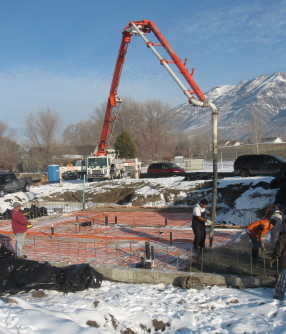
Today the concrete basement floors were poured! Few things are more exciting to two little boys that a cement mixer shooting rocks and goo out of a tube. So we bundled up in our snow gear and headed to the building site. And we watched the amazing concrete crew in action.
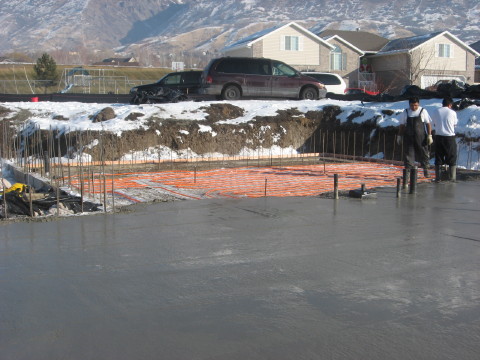
The team poured the cement over the miles of radiant floor tubing. It was exciting to see our future basement floors take shape, literally. They poured and troweled and floated the heavy mixture, wearing their knee-high boots, until it was smooth and gorgeous. A few hours later, when it had hardened somewhat, they were to come back and work the concrete by hand.
They made it look easy, but I know it is not. And they did it in near freezing weather.
The whole chilly outing made me most grateful that:
- I work indoors where it is warm
- Skilled tradesman are willing to work outdoors
It was such a big step to see the basement cement poured. With just a few basement floor drains and pipes sticking out of the vast expanse of concrete with some evidence of load-bearing walls, it’s starting to look serious. There is a solid foundation waiting for the house to be built up around it.
We can hardly wait for the next step.
Alison Moore Smith is a 62-year-old entrepreneur who graduated from BYU in 1987. She has been (very happily) married to Samuel M. Smith for 40 years. They are parents of six incredible children and grandparents to three astounding grandsons. She is the author of The 7 Success Habits of Homeschoolers.
I love seeing people brave the winter and move forward with construction. People often think construction stops in the winter, not at all true! Labor forces need a check just like the rest of us.
Did they cover the slab with insulating blankets?
.-= Todd – Home Construction & Improvement´s last blog ..Enduring the Cold with Roof Winterization Tips =-.
I was very pleasantly surprised to learn that they can keep building through the winter. When we finally closed in November, I was pretty sure we were sunk until early spring. Not so!
Yes, they are covering and heating everything. You can’t believe how many general contractors have asked me that! (Or maybe you can!)
Hello, I saw your link on Blog Engage. Looks like your project is coming right along! Best of luck with everything. – Dasche *day-sha*
Dasche, what a great name! Yes, I’m thrilled just to finally see it coming together. It’s been such a long process. Woot! Thanks for stopping by.
Looks fantastic but how will you add in reinforced walls without any exposed ironwork (from what I can see anyway)?
Anne, glad to see you here.
Do you mean exterior walls? There is rebar extending from the footings in the photos. Is that what you are looking for?
Hi alison,
The pictures look great! I’m not too sure about the soil around your parts, but freezing and thawing can cause cracks in your foundation over time, be sure to do some research about protecting your foundation in colder climates. I’ve subscribed to your feed so I can stay up to date on the project!
Thanks for you comment on our blog.
Absolutely. We’re in Utah and we have “the greatest snow on earth.” So, we do deal with the temperature ups and downs. Fortunately our builder is familiar with this climate. There has been a great deal of covering and heating of the concrete throughout the process. (Not so much on our last custom home!)
Fortunately, we seem to have just about come out of winter here. This week we’re in the 40’s and even 50’s. We may get another snow dump or two, but for the most part it’s only going to get better from here on out. Shout out to spring!
After this burst of enthusiasm last Thursday, we awoke on Friday to close to a foot of heavy, wet snow. Ahem. So I’m no climatologist.
This would be a difficult poor in these sorts of conditions. Great site pictures. This is the sort of pour where precast concrete might be ideal.
.-= Richard@precast concrete hopes you’ll read Precast Concrete Structural Products =-.
With proper care and maintenance, your concrete will flooring will definitely survive the test of times and extreme weather conditions. Before finally designing on the type of construction material to be used on your home or business establishment, conducting research will be of great help so that you can make a comparison.
Great post! I’ve always been curious about the process of pouring concrete basement floors, and this article really helped clarify things. It’s amazing how much work goes into making sure the floor is level, durable, and moisture-resistant, especially since basements can be prone to issues like water seepage. I like how you emphasized the importance of proper preparation—things like insulation, vapor barriers, and even the right mix of concrete really make a big difference in the long run. It’s also great to know that pouring the floor properly can help with energy efficiency and even make finishing the basement easier down the line. Thanks for breaking down the process so clearly!
This is such an informative post! I didn’t realize how much preparation goes into pouring a concrete basement floor. The steps you outlined, from proper leveling to ensuring good drainage, really highlight how crucial these elements are for long-term durability and moisture control. I also appreciated the mention of adding a vapor barrier and insulation—these seem like small details that can make a big difference in terms of energy efficiency and preventing future problems like mold or cracking. It’s clear that pouring a basement floor isn’t just about the concrete itself, but making sure everything underneath is right. Thanks for breaking down the process so clearly—this is definitely helpful for anyone considering a basement project!